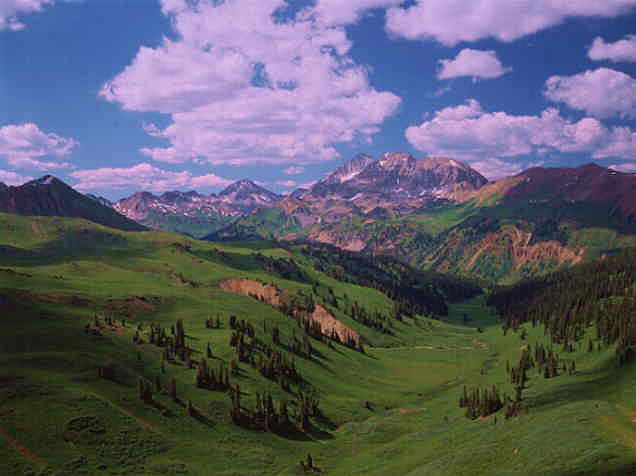
 The first movement is the beginning of the journey and opens with a long and contemplative pre-dawn section followed by a brilliant sunrise. The trek then begins in earnest and vista after vista are seen. The energy and spirit levels are very high as the protagonist observes Nature at its grandest. The opening Gaia theme was composed in 1969 along with the Hymn to Nature. I did a lot of work on the opening in 1979 while I was working in Denver. Each morning, I would drive down a long and lonely road to a remote job site at Rocky Mountain Arsenal and would see the sun rising on my right shining on the mountains on my left as I finalized the woodwind section. A lot of work was done in the spring of 2003, and the first completed draft was finished on August 9, 2003. The conclusion of this section was also composed in 1969 and with some refinements in later years. The music opens with a solo somber trumpet performing the Gaia theme (from Greek mythology and represents the mysterious vastness of Nature in both time and detail). There have been billions of sunrises before and there will be billions hence, so the music is unhurried. The scene is dawn prior to the sun making its first rays. Minimalist woodwinds then expand on the notes of the Gaia theme with harp and soft sustained strings in the background. The mood is mysterious and contemplative as the protagonist is packed and ready to undertake his trek and observes this special sunrise that marks the beginning of a quest to learn about Nature. As the first rays of the sun become visible the mood becomes brighter. The trumpets announce a fanfare as the sun begins its rise and the full orchestra triumphantly performs the Hymn to Nature theme as the new day begins. Except for an appearance in a minor key in the third movement, the hymn will not be heard in full again until the close of the fourth movement, although the opening phrase and variants are heard countless times throughout the work. The protagonist begins his trek. It is a brilliant day, and the protagonist is awe struck by the many mountain vistas, streams, lakes, forests, fields and all the wildlife at work. After a brief and spectacular introduction, the trek theme begins and has an energetic and yearning quality. Although he is alone, he has a sense that there is a guide leading him and pointing out all the many things that must be observed and noted. The protagonist will receive a lot of influence from the guide over the long journey. The protagonist yearns to see and understand more, and the music yearns with him. The music begins with the frolicking of the chipmunks and squirrels. Different variations of the theme are heard as other animals frolic in their own way. The first close is a broad theme signifying that all is well as the protagonist observes a mountain goat majestically overlooking the activities. The music concludes with the animals scattering as a bear approaches, and the frolic theme becomes a comic waltz in time with its clumsy antics. The music begins in a very grandeur manner. Variations of the horn call from the overture are played against an awe theme based on the pentatonic scale with woodwinds rippling in between. A grand march becomes mysterious and even frightful as the protagonist is in awe of the titanic forces that have shaped the sublime mountain peaks and huge rock formations. The music builds to an explosion of grandeur. The main theme of the overture is recalled, and the movement ends with the full orchestra playing the opening horn call of the overture to the scene of a brilliant afternoon sun shining on the expanse. The following are excerpts of the different parts for easy access. tron_movement1_part1.mp3 Score: tron_movement1_part1.pdf tron_movement1_part2.mp3 Score: tron_movement1_part2.pdf tron_movement1_part3.mp3 Score: tron_movement1_part3.pdf tron_movement1_part4.mp3 Score: tron_movement1_part4.pdf Back to the main The Revelation of Nature page Bottom of webpage |