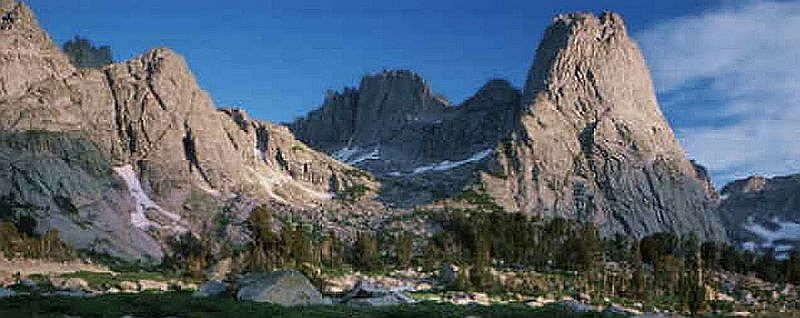
 The Revelation of Nature is an epic orchestral tone poem with overture and four half-hour movements chronicling a year-long trek through the seasons of the wilderness from summer to spring by an individual disillusioned with man-made religions who is seeking true understanding of the world. Throughout the journey there is an unseen guide pointing out the way and important observations to make. Near the conclusion of the fourth movement the guide is revealed, thus the title of the work. The protagonist, having completed the journey and now understanding many things, vows to teach humanity to work with Nature rather than against it. The work concludes with an awe-inspiring grand orchestral celebration as Nature rejoices that at least one human now understands the intended way to relate to the world - a world of fantastic beauty and harmony if only humans would cease their determination to impose arbitrary religious concepts based on man rather than Nature. Each movement can be listened to individually and the meaning contemplated. But there should be occasions where the entire work is heard in one setting. I provide only the basic structure of the overall story. Rather than listening passively, each listener should actively fill in his or her own details to create their own personal odyssey. Each listener must become the protagonist in order to fully appreciate the meaning of this work. Follow the protagonist through his journey and learn as he learns. Perhaps you will leave this music with a renewed attitude and be inspired to visit with and spend some quality time with Nature. Let the music be your unseen guide. This is appropriate since all dialogue between the guide and the protagonist is unspoken. The ultimate language of music expresses thoughts for which words are inadequate. The four movements, each of which is an individual tone poem, are: The Majesty of Summer, The Colors of Autumn, The Moods of Winter, and The Blossoms of Spring. The Overture introduces the music and sets the mood for the first movement to begin. Each movement is around a half-hour in length and the total performance time for this work is nearly two and a half hours. It is hard to describe how music sounds in words so the best description I can give is to imagine a combination of the very descriptive themes of The Grand Canyon Suite by Ferde Grofe and the sublime majesty of Sequoia, A Tone Painting by Homer C. LaGassey, and the grandeur of An Alpine Symphony by Richard Strauss. If you like these works you will probably like The Revelation of Nature. The music is an escape from the hectic pace of modern life. In some respects, the great length of this music is a protest against the attention deficit disorder society we presently live in. A journey through Nature is not supposed to be a quick fix - it takes time to contemplate and understand it all. Because of the sprawl of civilization, it is not easy to commune with Nature like it used to be. I have used the music many times as therapy to recover from an overdose of a human dominated world. For ease of navigation, there is a separate webpage below for each movement. Each page contains extensive descriptions and links to mp3 files and pdf scores of the orchestration. Overture to The Revelation of NatureMovement 1: The Majesty of Summer Movement 2: The Colors of Autumn Movement 3: The Moods of Winter Movement 4: The Blossoms of Spring Other pages:
History and Philosophical Discussion The work was begun in 1969, and the first draft was completed in 2003 as Cakewalk MIDI files using my Korg 01W/Pro synthesizer, which with some crafty programming did an excellent job of mimicking a symphony orchestra even though the Cakewalk files were far from real orchestration. Inspiration for this work came from countless long walks through the wilderness by the composer who essentially made this journey over the years and in many ways the work is autobiographical although the composer has always pictured himself as an observer of the protagonist's journey. Inspiration also came from travels through the Colorado Rocky Mountains in 1969 and 1979. In 2023 I began a complete orchestration using Finale and hope to complete that by 2026. The complete work has well over 2,000 measures! Unfortunately, Finale went out of business so the plan has been to complete the orchestration using the final version of Finale and then port that over to another music notation program known as Dorico using music XML but early tests indicate that a lot of manual adjustments will be required - but much less work than starting from scratch. Bottom of webpage |